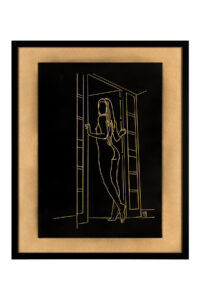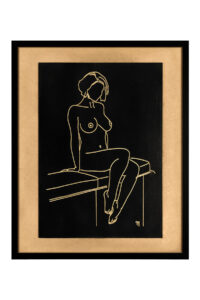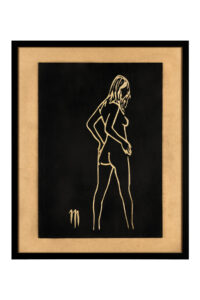
Manos Ioannidis’ Golden Nudes are works of line, rhythm and symbolism. By engraving golden contours onto black-painted plywood, the artist creates iconic compositions in which the nude body is reduced to its essential visual language, freed from the illusion of three-dimensional representation. The black background becomes an active field—a stage upon which light comes into being. Against this darkness, the golden line asserts itself, as though existence itself were emerging from the void. The precision of the contour transforms the figure into a visual script that reveals and conceals at the same time.
If Henri Matisse, through his celebrated découpages, revealed rhythm and harmony in the exuberant movement of the female body, Ioannidis monumentalises the female figure by concentrating on the purity of its outline. Without identity, individual features or psychological expression, the body becomes a universal symbol—a sign of form, rhythm and visual order.
This places Ioannidis in dialogue with Roy Lichtenstein, who, inspired by the language of comic books, reduced erotic imagery to its graphic essence. Whereas Lichtenstein exposed the mechanisms of desire through a stylised popular aesthetic, Ioannidis transforms desire into a visual code. The golden contour, dramatically contrasted against the black surface, converts physical flesh into an abstract archetype of feminine presence. Rather than depicting the body realistically, he reduces it to a semiotic trace—a personal visual ideogram. If Lichtenstein commented on the image culture of the twentieth century—print, comics and advertising—Ioannidis addresses the image culture of the twenty-first: digital, algorithmic, mediated and symbolic. His figures are hybrid inventions in which line precedes meaning.
An even more subtle dialogue can be traced with Allen Jones, the British artist who approached the female body as a postmodern fetish and a theatrical expression of commodified voyeurism. Ioannidis deliberately distances himself from such fetishisation. Femininity is no longer presented as an object of desire, but as the very idea of the body. Sexuality is not treated as provocation, but as symbol—a graphic notation of desire rather than its literal representation.
For this reason, Ioannidis’ Golden Nudes should not be understood as erotic images but as a visual vocabulary of desire. They translate femininity and eroticism into concepts rather than representations of physical seduction. By replacing the material presence of flesh with a luminous golden contour, desire itself becomes an abstract idea. Like an electrical flash cutting through darkness, the golden line awakens emotion. The body is no longer an image of sensual pleasure but an imaginative evocation of the ideal, of primordial longing and timeless attraction.
As in the red-figure pottery of ancient Greece, where the human body is defined by contour rather than mass, Ioannidis deconstructs and reconstructs the nude as light. His graphic figures become emblems of a different kind of eroticism—a universal sensuality detached from both theological symbolism and consumer culture.
From the archaic simplicity of Matisse to the graphic idealism of Lichtenstein and the theatrical fetishism of Allen Jones, Ioannidis develops a distinctly post-graphic visual language. Within this symbolic system, the female body functions not as an object but as a code—one that remains open to interpretation by every viewer.
Professor John Kolokotronis
Professor of the History and Theory of Western Art
Department of Architecture
Democritus University of Thrace
P.S. Golden Star Nudes is a set of Twenty Seven (27) engraved artworks size A3, Gold engraving on Black Plywood, framed. Following see three examples of the collection.